Informe Sonografico y Elastografia Shear Wave Hepática
ANTECEDENTES
Masculino de 46 años de edad, con antecedente familiar de diabetes mellitus. Diagnosticado previamente de esteatosis hepática grado II. Referido para evaluación hepática con elastografía Shear Wave.
HALLAZGOS SONOGRÁFICOS
Hígado aumentado de tamaño, con longitud cráneo-caudal de 16.7 cm (valor normal hasta 15 cm), compatible con hepatomegalia leve.
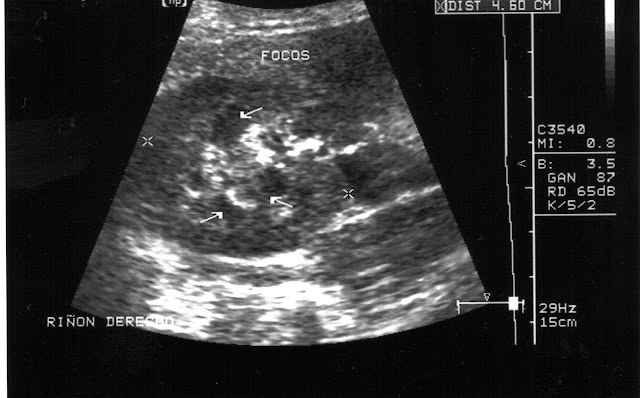
Presenta bordes regulares y ecogenicidad difusamente aumentada en comparación con la corteza renal derecha, conservando una homogeneidad parenquimatosa global.Los vasos intrahepáticos se observan de calibre y trayecto normales, sin signos indirectos de hipertensión portal.
El colédoco y las vías biliares intrahepáticas muestran calibres normales.
No se evidencian imágenes sugestivas de litiasis.
El hemidiafragma derecho y la pleura derecha se observan normales, sin evidencia de derrame pleural.
HALLAZGOS DE ELASTOGRAFÍA SHEAR WAVE (SWE)
Se realizó elastografía de onda de corte (Shear Wave Elastography), obteniéndose 10 mediciones válidas, realizadas en los segmentos VII y VIII, aproximadamente 2 cm por debajo de la cúpula diafragmática, con adecuada apnea transitoria del paciente.
Valor promedio (mediana): 10.65 kPa
Velocidad de propagación: 1.87 m/s
Índice hepato-renal (IHR): 3.20
Atenuación grasa hepática (ATT): 524 dB/cm/MHz
Los valores obtenidos son compatibles con esteatosis hepática grado II y con fibrosis hepática avanzada clínicamente significativa.
ESCALA DE FIBROSIS HEPÁTICA (SWE)
Equipo Philips Affiniti 70G
kPa m/s Estadio METAVIR Interpretación < 5.7 < 1.38 F0–F1 Fibrosis ausente o mínima 5.7 – 7.99 ~1.63 F2 Fibrosis moderada > 8.0 > 1.63 F3 Fibrosis significativa > 12.5 — F4 Cirrosis hepática Punto de corte (cut-off) clínico: 6.2 kPa
CONCLUSIÓN
Los hallazgos sonográficos y elastográficos son compatibles con:
Esteatosis hepática grado II
Hepatomegalia leve
Fibrosis hepática avanzada (F3), con valores de rigidez significativamente elevados (>8.0 kPa)
No se alcanzan valores diagnósticos concluyentes de cirrosis franca (F4), aunque el paciente presenta alto riesgo de progresión fibrosa.
RECOMENDACIONES
Correlacionar con hallazgos clínicos y pruebas de laboratorio que incluyan:
Perfil hepático completo
Marcadores virales
Perfil metabólico (glucosa, HbA1c, lípidos)
Seguimiento con Elastografía Shear Wave en 6–12 meses para evaluación evolutiva.
Considerar manejo multidisciplinario (hepatología/endocrinología).
ÍNDICES Y PARÁMETROS EVALUADOS
Índice hepato-renal (IHR)
Elastografía Shear Wave hepática
Atenuación grasa hepática (ATT)
Esteatosis hepática grado II
Hepatomegalia
🔍 OBSERVACIONES CRÍTICAS (Valor docente)
Un valor de 10.65 kPa se correlaciona de forma más consistente con F3, no con F4; por ello se recomienda evitar la expresión “F3–F4” como diagnóstico cerrado.
El valor de ATT > 500 dB/cm/MHz respalda de manera objetiva la carga grasa hepática significativa, reforzando la interpretación morfológica.
La correcta técnica (apnea, localización profunda, número de mediciones) aumenta la confiabilidad del estudio, aspecto clave en elastografía hepática.
Este caso ejemplifica el valor de la integración sonografía + SWE + ATT, más allá del hallazgo ecográfico aislado.
LIVER ULTRASOUND AND SHEAR WAVE ELASTOGRAPHY REPORT
CLINICAL HISTORY
46-year-old male with a family history of diabetes mellitus. Previously diagnosed with grade II hepatic steatosis. Referred for hepatic evaluation with Shear Wave Elastography (SWE).
ULTRASOUND FINDINGS
The liver is enlarged, with a craniocaudal length of 16.7 cm (normal up to 15 cm), consistent with mild hepatomegaly.
It shows regular contours and diffusely increased echogenicity compared to the right renal cortex, while maintaining overall homogeneous parenchymal texture.
Intrahepatic vessels show normal caliber and course, with no indirect signs of portal hypertension.
The common bile duct and intrahepatic bile ducts are of normal caliber.
No sonographic evidence of gallstones.
The right hemidiaphragm and right pleura appear normal, with no pleural effusion.
SHEAR WAVE ELASTOGRAPHY (SWE) FINDINGS
Shear Wave Elastography was performed, obtaining ten (10) valid measurements in segments VII and VIII, approximately 2 cm below the diaphragmatic dome, with adequate transient breath-hold.
-
Median stiffness value: 10.65 kPa
-
Shear wave velocity: 1.87 m/s
-
Hepato-renal index (HRI): 3.20
-
Hepatic fat attenuation (ATT): 524 dB/cm/MHz
These values are consistent with grade II hepatic steatosis and clinically significant advanced hepatic fibrosis.
HEPATIC FIBROSIS SCALE (SWE)
Philips Affiniti 70G system
| kPa | m/s | METAVIR Stage | Interpretation |
|---|---|---|---|
| < 5.7 | < 1.38 | F0–F1 | Absent or minimal fibrosis |
| 5.7 – 7.99 | ~1.63 | F2 | Moderate fibrosis |
| > 8.0 | > 1.63 | F3 | Significant fibrosis |
| > 12.5 | — | F4 | Liver cirrhosis |
Clinical cut-off value: 6.2 kPa
CONCLUSION
The ultrasound and elastography findings are consistent with:
-
Grade II hepatic steatosis
-
Mild hepatomegaly
-
Advanced hepatic fibrosis (F3), with liver stiffness values significantly elevated (>8.0 kPa)
Values do not reach definitive diagnostic thresholds for established cirrhosis (F4); however, the patient presents a high risk of fibrotic progression.
RECOMMENDATIONS
-
Correlate with clinical findings and laboratory studies, including:
-
Comprehensive liver function panel
-
Viral hepatitis markers
-
Metabolic profile (glucose, HbA1c, lipid panel)
-
-
Follow-up with Shear Wave Elastography in 6–12 months for longitudinal assessment.
-
Consider multidisciplinary management (hepatology/endocrinology).
ASSESSED PARAMETERS
-
Hepato-renal index (HRI)
-
Hepatic Shear Wave Elastography
-
Hepatic fat attenuation (ATT)
-
Grade II hepatic steatosis
-
Hepatomegaly
🔍 CRITICAL INSIGHTS (Educational Value)
-
A stiffness value of 10.65 kPa correlates more consistently with METAVIR F3, rather than F4; therefore, the term “F3–F4” should be avoided as a definitive diagnosis.
-
An ATT value >500 dB/cm/MHz objectively supports a significant hepatic fat burden, reinforcing the morphological ultrasound findings.
-
Proper technique (breath-hold, appropriate depth, and adequate number of valid measurements) enhances the reliability of SWE, which is essential for accurate fibrosis staging.
-
This case highlights the diagnostic value of integrating B-mode ultrasound, SWE, and ATT, beyond isolated grayscale findings.


Comentarios
Publicar un comentario