Diverticulitis aguda evaluada con Doppler y elastografía Shear Wave: correlación sonográfica integral
Acute Diverticulitis Evaluated with Doppler and Shear Wave Elastography: Comprehensive Sonographic Correlation
Clinical Background
A 56-year-old female patient, type 2 diabetic (non–insulin-dependent), with a known history of grade I–II hepatic steatosis and left renal lithiasis. She presents with intense left iliac fossa pain. Urinalysis is normal.
The clinical scenario requires a structured differential diagnosis approach: distal ureteral pathology, gynecologic disease, inflammatory colonic pathology, or diverticular complications.
Sonographic Findings
1️⃣ Liver
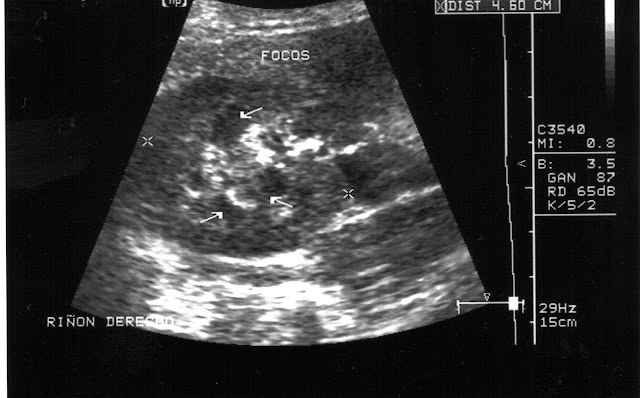
Diffuse increased hepatic echogenicity compared with the right renal cortex, consistent with grade I hepatic steatosis (Image 1).
No focal masses or vascular abnormalities are identified.
This is an incidental finding relative to the presenting complaint, but clinically relevant within the patient's metabolic context.
2️⃣ Sigmoid Colon
In the sigmoid region, multiple hyperechoic images deforming the colonic contour are visualized, consistent with diverticula.
One of them demonstrates:
-
Parietal wall thickening of 5.9 mm
-
Normal expected wall thickness: ≤ 3 mm
(Image 2)
This measurement strongly suggests active inflammatory involvement.
Color Doppler Findings
Increased vascular flow is observed within the diverticular wall (Image 3).
From a pathophysiological perspective, mural hyperemia directly reflects active inflammation.
This finding strengthens the diagnosis of diverticulitis rather than uncomplicated diverticulosis.
Shear Wave Elastography (SWE)
Five valid measurements were obtained from the inflamed diverticular wall.
-
Median stiffness: 4.67 kPa
-
Shear wave velocity: 1.25 m/s
(Image 4)
Critical Interpretation
In the normal colon, the wall is thin and demonstrates low stiffness.
In acute diverticulitis:
-
Wall thickness increases
-
Vascularity increases
-
Tissue stiffness changes due to edema and inflammatory infiltration
The measured value (4.67 kPa) is consistent with inflammatory stiffness, without reaching values suggestive of marked chronic fibrosis or infiltrative mass.
This provides an objective, quantifiable parameter that complements:
-
Morphology (wall thickening)
-
Hemodynamics (hyperemia)
-
Clinical symptomatology
Integrated Sonographic Diagnosis
Uncomplicated acute sigmoid diverticulitis.
No evidence of:
-
Peridiverticular collections
-
Abscess formation
-
Pneumoperitoneum
-
Obstructive complications
Clinical–Imaging Analysis
This case illustrates three diagnostic levels:
-
Structural → Wall thickening.
-
Functional vascular → Doppler hyperemia.
-
Quantitative biomechanical → Increased stiffness on SWE.
The integration of these three parameters enhances diagnostic confidence and may contribute to follow-up assessment without routinely resorting to computed tomography, particularly in metabolically vulnerable patients.
Final Considerations
-
Hepatic steatosis is a concurrent metabolic finding unrelated to the current painful episode.
-
The absence of renal findings excludes active lithiasis as the cause of pain.
-
Although intestinal elastography is not yet universally standardized, it may become a valuable complementary tool when critically integrated with the clinical context.
 |
| 1-Esteatosis Hepática |
 |
| 2-Pared Engrosada Divertículo Sigmoides |
 |
| 3-Doppler Pared Diverticulo |
 |
| 4-Elastografía Pared Divertículo |


Comentarios
Publicar un comentario