Nódulo tiroideo en paciente con síndrome de ovarios poliquísticos y obesidad mórbida
ANTECEDENTES
Femenina de 24 años de edad con obesidad mórbida e historia familiar de diabetes mellitus, diagnosticada con síndrome de ovarios poliquísticos.
Es enviada por su médico nutriólogo para evaluación sonográfica de tiroides.
HALLAZGOS SONOGRÁFICOS
El istmo tiroideo muestra una pequeña imagen anecogénica quística, que mide aproximadamente 6.9 x 3.3 mm (Foto 1).
El lóbulo derecho presenta una imagen microquística de aproximadamente 4,4 x 3,1 mm.
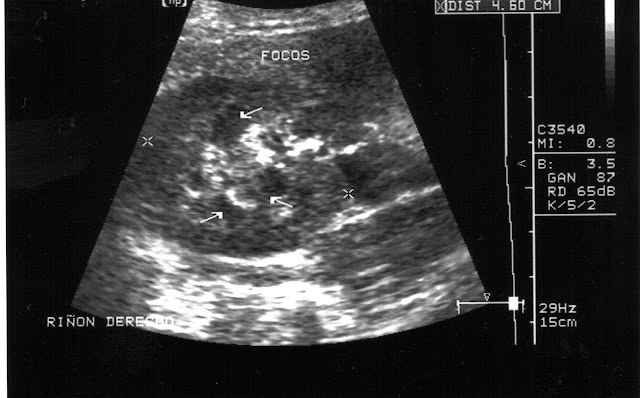
Además, se observa una imagen nodular sólida con microcalcificaciones internas y márgenes ligeramente irregulares, de 1.56 x 1.09 cm, más ancha que alta, con flujo interno y marginal leve en Doppler color (Foto 4).
Clasificación según ACR-TI-RADS 2017: 8 puntos (categoría 4 – sospechoso).
Según la escala simplificada sTI-RADS, corresponde a grado 3–4 (intermedio-sospechoso).
HALLAZGOS EN ELASTOGRAFÍA SHEAR WAVE
Se realizaron siete mediciones válidas dentro del nódulo, obteniéndose una mediana de 33,10 kPa y una velocidad de propagación de onda de 10,60 m/s.
ANÁLISIS
A pesar de los hallazgos ecográficos con características sospechosas de malignidad, la elastografía Shear Wave evidencia valores compatibles con nódulo benigno, lo que reduce de forma significativa la probabilidad de cáncer tiroideo.
Se recomienda seguimiento sonográfico periódico, destacando la alta precisión diagnóstica de la elastografía Shear Wave como herramienta complementaria en nódulos tiroideos de características intermedias o dudosas.
Thyroid nodule in a patient with polycystic ovary syndrome and morbid obesity
CLINICAL HISTORY
A 24-year-old female with morbid obesity and a family history of diabetes mellitus, previously diagnosed with polycystic ovary syndrome.
She was referred by her nutritionist for a thyroid ultrasound evaluation.
SONOGRAPHIC FINDINGS
The thyroid isthmus shows a small anechoic cystic image measuring approximately 6.9 x 3.3 mm (Image 1).
The right lobe demonstrates a microcystic image measuring about 4.4 x 3.1 mm.
In addition, a solid nodular lesion with internal microcalcifications and slightly irregular margins is observed, measuring 1.56 x 1.09 cm, which is wider than tall. It exhibits mild internal and peripheral vascularity on color Doppler (Image 4).
According to ACR-TI-RADS 2017, the lesion scores 8 points (category 4 – suspicious).
Based on the simplified sTI-RADS scale, it falls into grade 3–4 (intermediate to suspicious).
SHEAR WAVE ELASTOGRAPHY FINDINGS
A total of seven valid measurements were obtained within the nodule, showing a median stiffness of 33.10 kPa and a shear wave velocity of 10.60 m/s.
ANALYSIS
Despite the sonographic features suggesting possible malignancy, Shear Wave Elastography shows values consistent with a benign nodule, significantly reducing the likelihood of thyroid cancer.
Regular sonographic follow-up is recommended, highlighting the high diagnostic accuracy of Shear Wave Elastography as a complementary tool for thyroid nodules with indeterminate or intermediate features.
 |
| 1-Quiste Istmo |
 |
| 2-Microquiste Lobulo Derecho |
 |
| 3-Nodulo Solido con Microcalcificaciones |
 |
| 4-Doppler del Nodulo |
 |
| 5-Elastografia Shear Wear del Nodulo |
 |
| 6-Resultados de las mediciones |


Comentarios
Publicar un comentario